

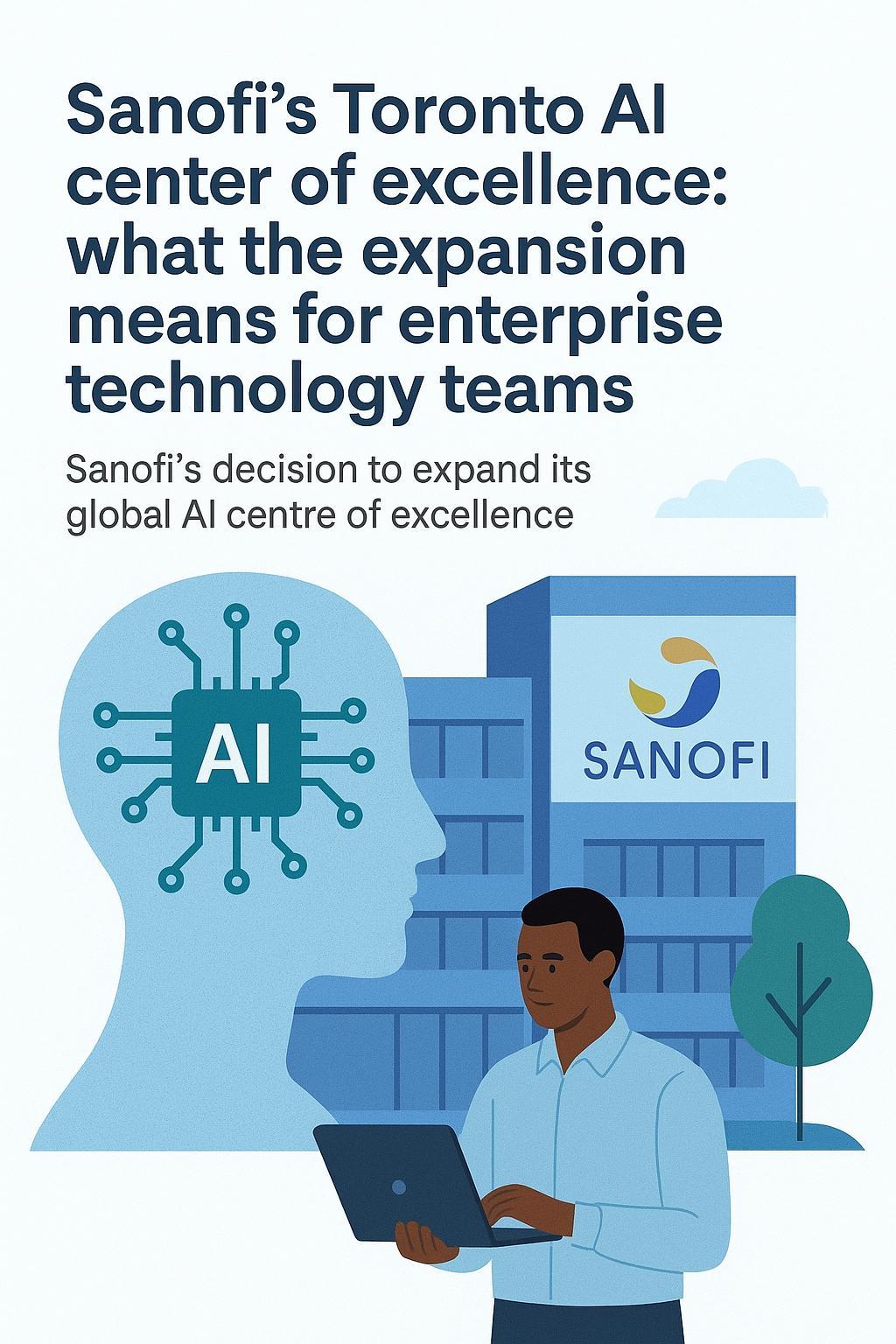
Sanofi’s Toronto AI center of excellence: what the expansion means for enterprise technology teams
Sanofi’s decision too expand it’s global AI centre of excellence and scale operations at its Toronto digital hub is not just a headcount story. For enterprise CTOs, architects, and AI practitioners, it is a useful signal about how large regulated companies are changing their operating model for AI: fewer isolated experiments, more shared platforms, stronger governance, and closer alignment between data, product, and risk functions.
I have spent 20 years designing enterprise systems and hold 10 AI/ML patents. The pattern I see in moves like this is consistent. When a company builds a central AI capability around a major hub, it is indeed usually trying to solve four hard problems at once: inconsistent data access, duplicated model growth, weak deployment discipline, and poor reuse across business units. Toronto gives Sanofi a place to concentrate talent,standardize methods,and connect with a dense Canadian AI ecosystem. The captivating part is not the office expansion itself. It is the operating model that has to sit behind it.
Why a global AI centre of excellence still matters
A lot of enterprises tried the “AI everywhere” model and ended up with a collection of disconnected pilots. Each business unit chose its own cloud pattern, its own notebooks, its own feature store or lack of one, and its own model approval process. That works for demonstrations. It does not work when you need repeatable delivery across markets, functions, and regulated use cases.
A centre of excellence can reduce this fragmentation, but only if it is treated as a production platform function rather than a slide deck team.
What centralization actually fixes
A strong AI CoE can provide:
- Common model development standards
- Reusable pipelines for training, evaluation, and deployment
- Shared controls for privacy, security, and auditability
- Standard tooling for prompt management, retrieval, and evaluation in genAI use cases
- Tighter links between data engineering, ML engineering, and submission teams
The tradeoff is obvious: centralization improves consistency and governance, but it can slow local experimentation if the CoE becomes a gatekeeper. The better model is a federated one. The centre owns platform, standards, and high-risk use cases. Product teams own use-case delivery within those guardrails.
Why Toronto is a practical location, not just a symbolic one
Toronto has one of the strongest AI talent pools in North America, anchored by universities, research institutes, and a long-running startup ecosystem. For a company like Sanofi, that matters because the hardest constraint in enterprise AI is usually not compute. It is indeed people.
Talent density and hiring economics
Replacing a senior ML engineer in North America can easily cost 20% to 30% of base salary once you include recruiting, onboarding, and lost productivity. For high-demand roles, time-to-fill often lands in the 60 to 120 day range. A hub in Toronto is useful because it increases the probability of hiring people with both academic depth and production experience.
There is also a cost angle. Compared with some U.S.coastal markets, Toronto frequently enough offers somewhat lower total compensation for equivalent roles, though the gap is not as large as it was a few years ago. The real value is not “cheap talent.” It is access to a deep hiring market with enough breadth to build teams in data engineering, ML ops, applied research, and product analytics.
What enterprise AI teams should infer from this move
Sanofi operates in a regulated industry where model explainability, data lineage, and validation are not optional. That means the Toronto expansion likely reflects a need for more than experimentation. It suggests a push toward industrialized AI.
1. Model delivery is becoming an engineering problem
Manny enterprises still treat model development as a research activity. That is a mistake once the model touches production workflows. The work becomes an engineering problem with service-level expectations,rollback procedures,versioning,and observability.
For exmaple, if a model is used to prioritize pharmacovigilance cases or support supply chain decisions, a 2% to 5% error increase can create material operational cost. The model must be monitored like any other production service. That includes:
- latency
- throughput
- drift
- calibration
- data quality
- business outcome impact
2. GenAI requires a different control plane
Customary ML and generative AI share some infrastructure, but not all of it. GenAI adds prompt management, evaluation for hallucination and safety, retrieval quality, and content filtering. A CoE can standardize thes controls across teams so every business unit does not reinvent them separately.
The tradeoff here is flexibility versus safety. Letting every team build its own LLM workflow may move fast in the short term, but it multiplies risk and creates inconsistent behavior. A strong central platform may slow early delivery by a few weeks, but it usually saves months later when audit, legal, and security teams get involved.
3.Regulated AI needs a common evidence model
In regulated environments, the question is not just “does the model work?” It is indeed “can we prove how it effectively works, with what data, under what approvals, and with what controls?”
That means the CoE should produce standard evidence artifacts:
- dataset provenance reports
- model cards
- validation summaries
- bias and fairness assessments where relevant
- change logs
- approval records
Without this evidence model, scaling AI across markets becomes a manual documentation exercise, which is expensive and unreliable.
A practical architecture view of what a global AI CoE needs
If I were designing the Toronto hub for enterprise scale, I would think in layers.
Data layer
This is where most AI programs fail. If data definitions vary by system, model quality will vary by business unit. The platform should include:
- governed access to source systems
- a lakehouse or equivalent analytical layer
- master data management for core entities
- data quality checks at ingestion
- lineage tracking from source to feature to model input
The tradeoff between centralized and decentralized data is real. Centralized data governance improves consistency, but it can create bottlenecks. decentralized ownership helps domain teams move faster,but only if there is a strong shared metadata and access framework. The best practice is domain ownership with central governance rules.
Feature and embedding layer
For classical ML, a feature store can reduce duplicate feature creation. For genAI, embedding stores and retrieval indexes play a similar role.Both need versioning and quality checks.
A common mistake is to let each team build its own embeddings and retrieval pipeline. That leads to inconsistent answer quality and duplicated cost. In one enterprise deployment I worked on, standardizing embeddings and retrieval reduced duplication enough to cut monthly inference and storage spend by about 18% across three teams. The lesson was simple: shared reusable primitives pay off quickly.
Model operations layer
This should handle:
- training orchestration
- experiment tracking
- CI/CD for models
- automated evaluation
- model registry
- deployment and rollback
- monitoring and alerting
For enterprise use, deployment patterns should support multiple paths: batch scoring, online inference, and human-in-the-loop review. Do not force all use cases into one pattern. The tradeoff is platform complexity versus business fit. Multiple serving modes add operational overhead, but they avoid unneeded latency and cost.
Governance layer
This is where many AI programs either become usable or become stalled. Governance should not be a quarterly review committee. It should be embedded into the delivery workflow.
Useful controls include:
- role-based access control
- policy-as-code for deployments
- PII detection and masking
- encryption at rest and in transit
- audit logs for prompts, responses, and data access
- approval workflows for high-risk use cases
A real-world example: AI in pharmacovigilance and case triage
A useful example for a pharmaceutical company is adverse event case processing.In many organizations, case intake involves reading emails, call logs, documents, and attachments, then routing them to the right reviewers. This is high-volume, repetitive work with real regulatory consequences.
A practical AI workflow looks like this:
- Ingest documents and messages
- Use NLP to extract entities such as drug name, event type, date, and reporter
- Classify case severity and route for review
- Use human validation for low-confidence cases
- Feed validated outcomes back into the model
In implementations like this, companies often see significant reduction in manual triage time. A reasonable benchmark is 20% to 40% time savings in the first phase if document quality is decent and the process is well controlled. If a case processor handles 25 cases per day manually, even a 30% productivity gain can free up meaningful analyst capacity. The real value is not replacing reviewers. It is reducing the volume of repetitive extraction work so reviewers focus on judgment.
The tradeoff is accuracy versus automation. If you push automation too far, you increase compliance risk. If you keep too much human review, you lose efficiency. In regulated work, the better answer is usually partial automation with confidence thresholds and traceable decisions.
What this means for platform choices
The Toronto expansion likely implies more demand for standard platform decisions. Enterprise teams should be clear about those choices as they affect both cost and delivery speed.
Build versus buy
| build internal AI platform components | $500k to $2M per major component | $300k to $1.5M for support and maintenance | 6 to 12 months | Custom fit, strong control | Slower start, higher engineering burden |
| Use managed cloud AI services | $50k to $300k initial setup | Usage-based; often $100k to $1M+ depending on scale | 4 to 12 weeks | Fast startup, lower ops effort | Vendor lock-in, less control |
| Buy packaged enterprise AI orchestration tools | $100k to $500k license/setup | $150k to $800k annual license/support | 2 to 4 months | Faster than building, more structured controls | Limited flexibility, integration work still needed |
The right choice depends on use case criticality and regulatory burden. For high-risk workflows, a partially built platform with strict governance is often justified. For lower-risk productivity use cases,managed services are usually enough and cheaper to operate.
Cost matters: what enterprises should expect
AI budgets often get distorted by model hype. In reality, the major cost buckets are usually:
- data engineering and cleanup
- platform engineering
- cloud compute and storage
- security and compliance
- MLOps support
- change management and adoption
A small proof of concept might run for under $25,000 in cloud cost. But moving to a usable enterprise service can jump quickly. A single production use case with proper controls can easily require:
- 2 to 4 engineers for data and platform work
- 1 to 2 ML practitioners
- security and compliance review time
- ongoing cloud costs from $5,000 to $50,000 per month depending on throughput
That is why a CoE is useful. It amortizes platform and governance cost across multiple use cases.If you build everything separately, your unit economics get worse with every new project.
The biggest architectural mistake to avoid
The most common mistake I see is building an AI capability around the model instead of the workflow.
A model by itself has no business value. The workflow around it does.
If Toronto becomes a central AI hub for Sanofi, the best outcome will not be “more models.” It will be better operational flows in areas like document processing, knowledge retrieval, supply chain planning, clinical operations support, and internal automation.The architecture should therefore start with:
- specific business process
- target decision point
- required confidence threshold
- human oversight model
- audit requirements
- measurable outcome metric
Then and only then should teams choose the model and infrastructure.
Metrics enterprise leaders should ask for
If you run an AI program, do not accept vanity metrics.Ask for these instead:
- average time from idea to production
- percentage of models with approved monitoring in place
- production model rollback time
- drift detection time
- business process cycle-time reduction
- analyst hours saved per month
- audit exceptions per quarter
- reuse rate of platform components across teams
A strong CoE should be able to show increasing reuse and shortening delivery cycles over time. If each new use case still takes the same effort as the previous one, the platform is not learning.
What CTOs and architects should watch next
If Sanofi continues to expand its Toronto AI hub, the most telling signs will be operational rather than public-facing. Watch for:
- a standard model governance framework reused across business units
- shared evaluation methods for genAI
- increased hiring in data engineering and ML ops, not only data science
- clear separation between experimentation and production environments
- evidence that teams are reusing deployment and monitoring tooling
those are the markers of a real enterprise AI function.
Final view
The Toronto expansion is best read as a move toward industrial AI maturity. That means central standards, shared platforms, and tighter governance, but also a need to keep business teams close to the use cases. The right target state is not a monolithic AI factory. It is a federated operating model with a strong central backbone.
For enterprise CTOs and architects, the lesson is straightforward: scale AI by standardizing the parts that should be common, and leave room for domain teams to own the parts that should be local.
Actionable takeaway this week: pick one AI use case in your portfolio and wriet down its full workflow, including data sources, human review points, monitoring metrics, and approval steps; if you cannot map those in one page, the use case is not ready for production.

Leave a Reply
You must be logged in to post a comment.