

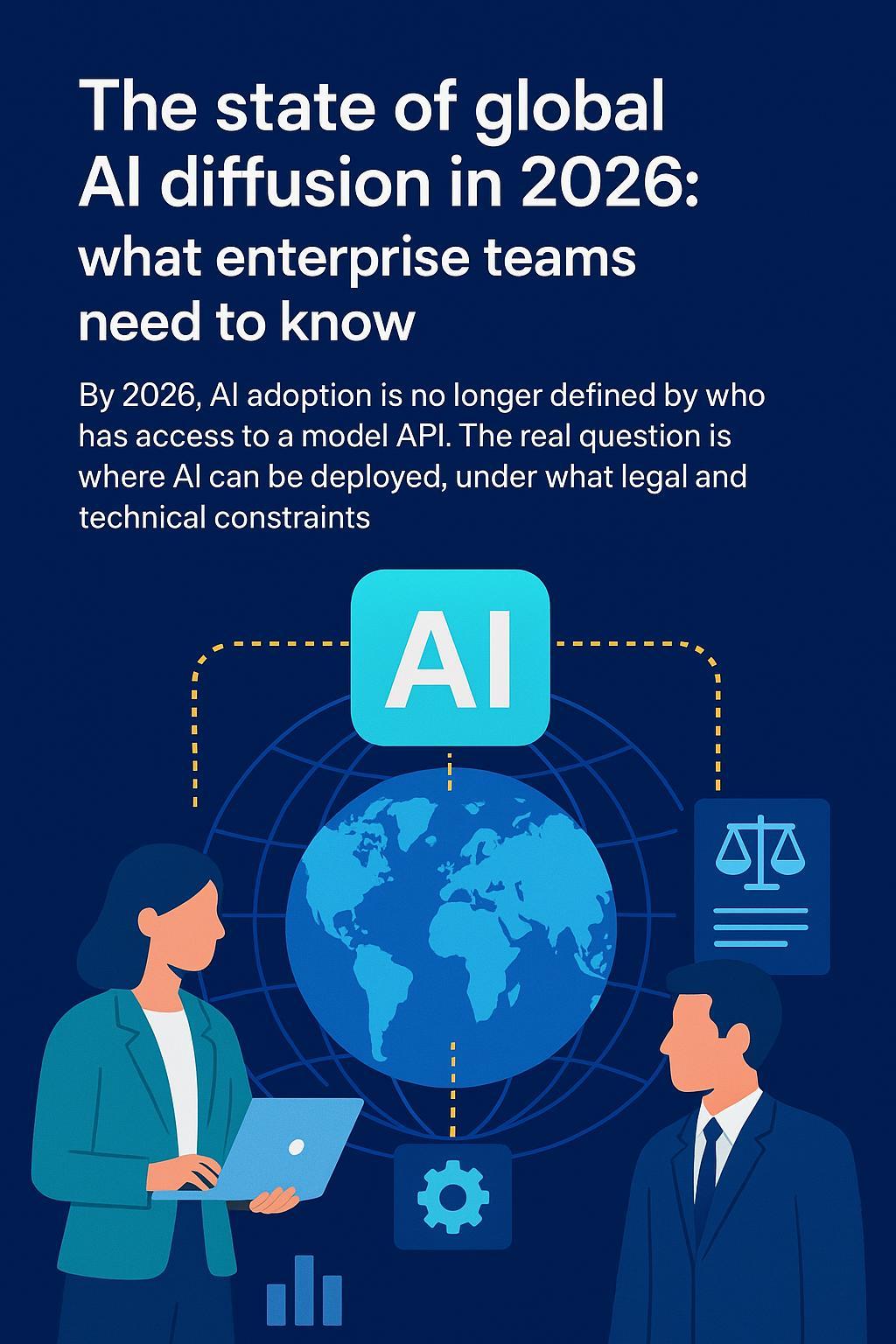
## The state of global AI diffusion in 2026: what enterprise teams need to knowBy 2026, AI adoption is no longer defined by who has access to a model API. The real question is where AI can be deployed, under what legal and technical constraints, and how much of the stack an enterprise can control.For CTOs,architects,and AI practitioners,the topic is not “Should we use AI?” It is “How do we build systems that survive regional policy shifts,compute shortages,cost pressure,model drift,and data governance requirements?”Microsoft’s reporting on AI diffusion points to a clear pattern: AI is spreading globally,but not evenly. A few markets have the compute, talent, capital, and cloud availability to move quickly. Many others are adopting AI through managed services, imported models, or narrow domain deployments. The result is a world where AI capability is increasingly present, but operational maturity varies widely.I have spent two decades in architecture work and have filed 10 AI/ML patents across applied machine learning, distributed systems, and decision automation. My view is practical: diffusion matters becuase it determines what can actually be deployed in production. If an enterprise ignores diffusion, it will overestimate feasibility, underestimate cost, and misread which controls are necessary for reliability and compliance.## What “AI diffusion” means for enterprisesAI diffusion is not just model access. It includes:
– Availability of compute, especially GPUs and accelerators
– Availability of models, including open and closed weights
- Cloud and edge infrastructure that can support inference
– Local data protection and AI regulations
– Availability of skilled operators, data engineers, and security teams
– Cost of training, fine-tuning, and serving models
– Language coverage and domain-specific readinessFor enterprise teams, the practical outcome is that AI deployment no longer follows a single global pattern. A design that works in the United States may fail in the EU because of stricter legal review, in India because of data transfer requirements, or in parts of Africa and Latin America because latency, local cloud capacity, or payment rails make serving large models expensive.The top architectural mistake in 2024 and 2025 was assuming that a single “global” AI platform could roll out unchanged across regions.In 2026, the better pattern is regional variation with central governance.## The diffusion pattern in 2026: broad use, uneven depthThe current state of adoption can be summarized simply: usage is broad; deep integration is concentrated.Many organizations now use AI for:
– Document summarization
– Search and retrieval
– Agent-assisted support
– Code generation
– Call center triage
– internal knowledge lookup
– Drafting and classification tasksFewer organizations have:
- Model evaluation pipelines tied to business KPIs
– Multi-region policy enforcement
– Secure prompt and output logging
– Formal fallback logic for model outage or low confidence
- Cost-aware routing across model tiers
– Observability for token usage, latency, and hallucination ratesThat gap matters. A proof of concept can be run by a small team in weeks. A production deployment with governance, regional controls, and measurable business value takes months. Enterprises that confuse the two usually overspend on model quality while underinvesting in integration and controls.## Regional differences are now architectural constraints### North AmericaNorth America remains the strongest region for access to frontier models, cloud infrastructure, and AI talent. Enterprises can often get the latest services first, and public cloud integration is mature. The tradeoff is not speed; it is dependence. If your operating model relies heavily on one cloud provider or one model vendor, your supply chain risk increases.### EuropeEurope has strong enterprise demand and strong governance. The tradeoff is slower rollout. Data residency, works council scrutiny, GDPR interpretation, and emerging AI regulation all affect deployment. For many organizations,the right design is not to block AI,but to partition it: keep some models and logs in-region,use synthetic or masked data for testing,and route sensitive workloads separately.### Asia-PacificAPAC is the most diverse region. some markets are highly advanced in digital operations and mobile-first deployment. Others face uneven cloud access or local compliance complexity. Enterprises operating across APAC usually need more service variants than they expect. One model serving strategy rarely works everywhere as language, transaction volume, and latency profiles differ too much.### Latin America, Middle East, and Africathese regions are seeing real adoption, but mostly through targeted use cases.the common pattern is not training frontier models locally; it is using hosted inference,RAG over internal documents,and automation around customer support or fraud checks. Cost per request matters more here because throughput is lower and cloud economics are less forgiving.Such as,a deployment that costs $40,000 per month in one region may be acceptable for a global bank,but impractical for a mid-market insurer unless it is tightly scoped.## What the Microsoft perspective implies for enterprise architectureMicrosoft’s view of AI diffusion is useful as it reflects a large operational footprint: cloud, productivity software, developer tooling, security, and enterprise support. The implication is straightforward: AI adoption is moving from standalone experimentation into existing enterprise systems.That means architecture has shifted from “pick a model” to “design an operating layer for models.” That layer includes:
– Identity and access control
– Data segmentation
– Prompt and response logging
– retrieval policy
– Rate limiting and cost controls
- Evaluation and human review
– Regional failover and vendor fallbackThis is the part many teams still miss. The model itself is only a component. The enterprise value comes from the system around it.## A practical comparison: model API, hosted platform, or self-hosted open weightsThe most common deployment choices in 2026 are still the same three, but the tradeoffs matter more than before.
| Managed model API | $5,000 to $150,000+ | Fastest to launch, strongest model quality, low ops burden | Vendor dependence, variable token costs, data residency limits | Teams needing rapid rollout and strong quality |
| Hosted enterprise platform | $20,000 to $300,000+ | Better governance, identity integration, admin controls, auditing | Higher platform cost, less model choice, slower experimentation | Large enterprises with compliance and IT controls |
| Self-hosted open weights | $15,000 to $500,000+ | More control, predictable local deployment, better data isolation | GPU cost, tuning burden, patching, evaluation, staffing needs | Regulated industries and high-volume internal use cases |
The tradeoff is not abstract. Managed apis are usually the cheapest to start and the most expensive to scale if requests are high-volume. Self-hosting can reduce long-run dependency and supports stricter data control, but it requires real operational maturity. Hosted enterprise platforms sit in the middle: they reduce risk and speed up enterprise integration, but they can lock you into one vendor’s abstraction and pricing.A simple rule: choose the least complex option that still satisfies your governance and performance requirements. Too many teams reverse that logic and over-engineer from day one.## Cost pressure is changing adoption decisionsAI diffusion in 2026 is being shaped as much by cost as by capability. for many teams, the first bill that gets attention is not infrastructure, but tokens.A common enterprise pattern looks like this:
– 10,000 employee-assist users
– 15 prompts per user per day
- 300 tokens input and 500 tokens output per prompt
– Roughly 120 million tokens per day across the organizationAt that scale, small per-token differences become large monthly costs. If one model tier is 3x more expensive than another, the difference might potentially be $50,000 to $250,000 monthly depending on usage. that is why model routing is becoming standard practice: send simple tasks to smaller models, reserve larger models for hard cases, and add confidence thresholds.The tradeoff is quality versus spend. Smaller models are fast and cheap, but they fail more often on long-context reasoning, policy nuance, and complex synthesis. Larger models are better at those tasks, but they drive the bill. Enterprises should measure this directly rather of debating it in theory.## A real-world case study: microsoft Copilot in a regulated enterprise environmentOne useful example is a regulated financial-services organization implementing Microsoft 365 Copilot across knowledge workers. The organization had three user groups: general staff, compliance staff, and customer-facing specialists. The initial pilot covered document drafting, meeting summaries, and internal search.The first lesson was that broad licensing without scoped governance caused friction. The compliance team could not accept the same data exposure policy as the broader employee base. The second lesson was cost. If all 8,000 employees were enabled at once,the expected annual license cost would have been several million dollars before usage-driven scaling,and the organization would have had limited proof of productivity advancement.The actual deployment strategy was narrower:
– Start with 600 users in legal, finance, and product management
– Restrict access to approved SharePoint and teams repositories
– Apply sensitivity labels before enabling retrieval
– Measure time saved on meeting summaries and draftingIn the first several months, the biggest value was not flashy content generation. It was reduced time spent searching for internal documents and creating first drafts. The team also found that governance mattered more than model quality: if the retrieval layer was poor, the assistant became less useful regardless of underlying model capability.The tradeoff here was clear. A broader rollout would have looked notable but created more legal review, more support load, and more data quality problems. A narrower rollout produced evidence, control, and a repeatable pattern for expansion.## What architects should build into the 2026 AI stack### 1. A policy layer before the model layerEvery request should pass through policy checks:
- User identity
– Data classification
– Allowed tools
– Region restrictions
– Output filtering
– Logging rulesIf policy is bolted on after the model, you are already exposed.### 2. Model routing by task classNot every task needs the same model. A good routing strategy usually has:
– small model for classification, extraction, and short summaries
– Mid-tier model for internal Q&A
– Larger model for complex reasoning or cross-document synthesisThis can cut inference cost by 30% to 70% in some workloads, depending on traffic mix. The tradeoff is routing complexity. You need evaluation data and fallback logic or the system will misroute edge cases.### 3. Retrieval as a governed serviceRAG is not just a search feature.It is a data access layer. Treat it that way:
– Index only approved content
– track source provenance
– Refresh embeddings on a defined schedule
– Separate public, internal, and restricted corpora
– log the documents used in each answerIf you do not control retrieval, you do not control output quality.### 4. Evaluation tied to business metricsDo not rely only on BLEU, ROUGE, or generic answer quality scores. Track:
– Time to resolution
– Ticket deflection rate
– Analyst hours saved
– Hallucination rate on sampled outputs
– Escalation rate to human review
- Cost per accomplished taskThe point of AI is not model impressiveness. it is measurable task improvement.## The regulatory direction is toward more localization, not lessA common misconception is that AI governance will converge globally. The opposite is more likely. Data sovereignty, AI disclosure rules, sector-specific oversight, and procurement requirements will continue to vary by region.That means the enterprise AI architecture in 2026 should assume:
– Regional hosting options
– Multiple model providers
– Configurable logging policies
– Contractual controls for training data use
– Separate evaluation baselines by geographyThe tradeoff is operational sprawl. Multiple regions and providers increase complexity. But a single centralized design can become noncompliant or unavailable in entire markets. For multinational organizations, controlled duplication is usually cheaper than repeated legal exceptions.## What practitioners should watch nextThe big trend is not a single model getting better by 10%.It is indeed the spread of AI into every layer of work:
– Search
– Writing
– Decision support
– Software progress
– Customer service
– Security operations
– Back-office automationThat spread creates both chance and risk. The opportunity is productivity. The risk is uncontrolled sprawl: multiple point solutions,hidden data movement,inconsistent answers,and rising costs.Enterprises that succeed in 2026 will do three things well:
1. Standardize how models are accessed
2. Measure value at the task level
3.Localize only where regulation, latency, or economics demand itThat is the real meaning of diffusion. AI is no longer rare. The scarce resource is disciplined deployment.## The practical bottom line for CTOs and architectsIf you are leading an enterprise AI programme, stop asking which model is best in the abstract. Ask:
- Where can this workload legally run?
– What is the acceptable latency?
– What is the cost ceiling per successful task?
– What data can the model see?
– What happens when the model is wrong or unavailable?
– Which parts must stay regional?Those questions drive architecture more than model charts do.The state of global AI diffusion in 2026 is not uniform adoption.It is indeed uneven capability, with strong regional differences in infrastructure, regulation, and operating maturity. The enterprises that understand those differences will build systems that scale. The ones that do not will keep paying for pilots that cannot survive contact with production.The actionable takeaway for this week: inventory one AI use case in your organization, classify its data by region and sensitivity, and define a fallback path to a smaller or hostable model if the preferred model is unavailable or noncompliant.


Leave a Reply
You must be logged in to post a comment.